8D7N Explore Mentawai Tribe Cultural
Duration
8 Days 7 Nights
Overview
Tracing the traces of the Mentawai Tribe is like opening a new chapter in the journey of understanding Indonesia’s cultural richness. Their persistence in preserving nature and ancestral heritage should be an inspiration to all of us.
Focus: Cultural Immersion, Tribal Living Experience With The Mentawai Tribe
Our Journey to Mentawai (Siberut)
Day 1: Crossing and Heading to the Inland Forest (MENTAWAI)
In the morning, at 7:00 a.m., you will board a fast boat (such as the Mentawai Fast) from Muaro Padang Harbor to Siberut Island. The journey typically takes 3 to 6 hours, depending on the boat’s schedule. (For example, if you choose a Tuesday or Saturday, you will spend 6 hours on the boat, as the boat will transit at Sikabaluan Harbor. The 1-hour transit will then continue to Siberut for another 2 hours.) Upon arrival at the Siberut pier, continue your journey by wooden boat (pompong/boat) along the river to the Mentawai tribe. From here, you will embark on a jungle trek with a local guide to the Mentawai tribe settlement in the interior, approximately 1.5 hours away. Upon arrival, you will be greeted by a Mentawai family and stay overnight in their traditional house(UMA)
Upon arrival in South Siberut, from the harbor, we will head to a nearby transit village before embarking on a scenic river journey on a traditional motorboat, passing through the dense jungle landscape. (Travel to a nearby transit village before embarking on a scenic river journey on a traditional motorboat, passing through the dense jungle landscape in the heart of Siberut.) After reaching the trekking point, we will continue our journey on foot through the rainforest to our tribal home in the Mentawai Islands. You will be expected to trek through several muddy swamp forest areas, where you will meet Mentawai healers and their families, and gain in-depth insights into our ancient traditions and way of life.
Day 2 to 4 : Immersion in the Mentawai Tribe – Rereiket Jungle
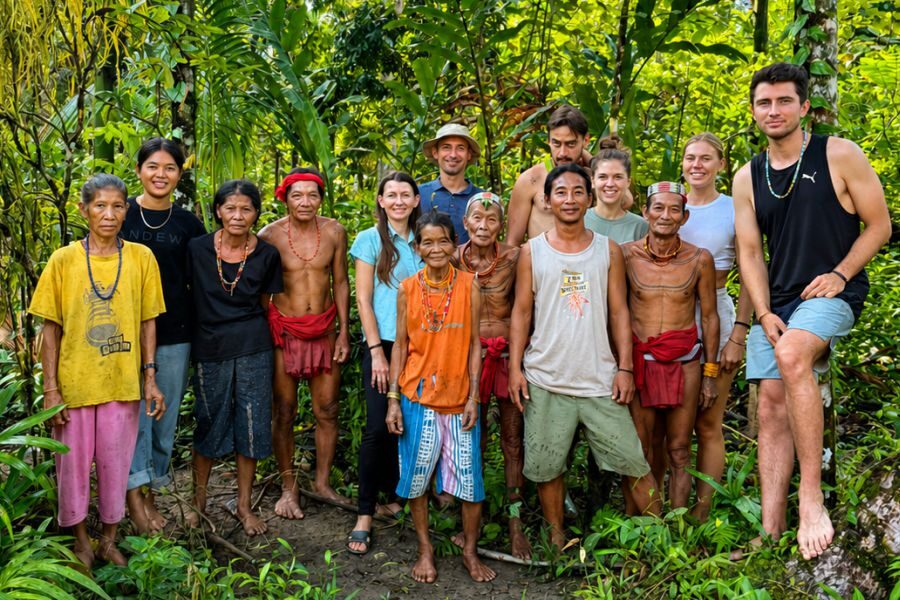
Experience authentic Mentawai life as you stay with our family in the remote Rereiket forest. Participate in daily activities, including traditional meal preparation and foraging in the forest, and learn how our tribe gathers and prepares food from Mentawai’s natural resources. During your stay in Mentawai, you will have the opportunity to fully immerse yourself in our Mentawai way of life, gaining firsthand insight into our ancestral traditions, learning survival skills, and our relationship with nature. Take advantage of this unique opportunity to interact with your hosts and healers, ask questions, and hear stories about our culture, rituals, and beliefs, creating a rich and unparalleled cultural exchange.
Day 5 to 7 : Explore different jungle areas and different families (MAOPU)
This trip was very challenging in the jungle but rewarding, visiting various communities. This climb requires endurance and physical stamina, as we will be traversing dense tropical vegetation, crossing rivers and navigating dirty and slippery terrain. Living with our Mentawai tribe in a natural environment is an unparalleled experience for those looking for a deep cultural connection and a closer bond with nature. By engaging with our daily routines, traditions, and survival techniques, you’ll gain an in-depth new perspective on our indigenous life in Mentawai.
Day 8 :
In the morning after breakfast around 8am.we will Ride back to our transit village with the motor canoe ( 2,5 h ), to the port of maileppet, Arrive at the harbor, Lunch at the local restaurant, and at 14:30, back to Padang.(Tour end)
Price
£690
Package Single
(Solo Travel)
£350
Package Group
(Min 2-3 people) / Pax
£315
Package Group
(Min 4-5 people) / Pax
£350
Package Family
(Min 2-3 people) / Pax
£315
Package Family
(Min 4-5 people) / Pax
£230
Package Children
(under 5-12 years ) / Child
(NOTE) this price all organized from the city of padang, buying ferry tickets 1 day before the tour start, breafing at the hostel where u stay in padang before the tour start, picking up from the hostel to the port).
-
- Mentawai fast Ferry ticket (2 ways).
- Meals & beverages during the tour.
- Permit for Local Government and Siberut National Park.
- Specialist English speaking guide.
- Provided support from Local teams only (We are originally from Siberut Island, Mentawai not big tour operator or guide from Padang).
- Pick up car/motorbike transport from Maileppet harbor to get to the transit village.
- Dugout canoe (River transport).
- Porters for logistics.
- Accommodation at Mentawai Uma traditional house.
- Sharing the real Mentawai way of life.
- Provided mosquito net and simple mattress.
- Rubber boots for mud treks (be ready to walk in swampy jungle area, sometimes your feet will get sink, and log slippery to access further road). We got size from 37-43.
- Generous local gifts (black tobacco, cigarette, coffee, and tea).
- Contribution donation to our Mentawai family.
1.) A Brief History
The Mentawai tribe is an indigenous tribe that inhabits the Mentawai Islands, about 140 km off the west coast of West Sumatra. This tribe is famous for its unique culture and is still preserved to this day.
The ancestors of the Mentawai Tribe are believed to have migrated to the Mentawai Islands between 2000-500 BC. They are part of the Austronesian family and have kinship relationships with other tribes in Sumatra and Kalimantan.
2.) Culture
The Mentawai tribe has a rich and diverse culture. One of their distinctive features is the tattoo that adorns almost the entire body. This tattoo is not only an ornament, but it also has a magical and spiritual meaning.The Mentawai tribe is also famous for their tradition of sharpening their teeth. This tradition is carried out as a symbol of beauty and strength. In addition, they also have various rituals and traditional ceremonies that are still preserved today.
3.) Lifestyle
The Mentawai tribe live semi-nomadic, moving from one place to another in search of food. They rely on nature to meet their life needs, such as hunting, fishing, and farming.
4.) Traditional House
The Mentawai tribe lived in a traditional house called “uma”. Uma is made of wood and has a thatched roof. This house is usually inhabited by several families.
5.) Language
The Mentawai tribe has its own language called the Mentawai language. It is part of the Austronesian family and has several dialects.
Threats and Challenges
The Mentawai tribe is currently facing various threats and challenges, such as forest destruction, climate change, and cultural acculturation. This can jeopardize the preservation of their culture.
Conservation Efforts
Various efforts have been made to preserve the culture of the Mentawai Tribe, such as:
Cultural research and documentation
Education and training for the Mentawai community
Sustainable development of cultural tourism
With these efforts, it is hoped that the culture of the Mentawai Tribe can continue to be sustainable and inherited to the next generation.”
Things to know our living with the Mentawai tribe
- Don’t assume it’s like a hotel. There’s also clear river water flowing from the hills, so if you want to bathe, don’t be naked.
- There are no closed toilets; you’ll have to relieve yourself in the forest.
- We stay in traditional houses with mattresses and mosquito nets.
- There’s no electricity (they generally use solar panels for lighting) and no signal while in the interior.
- There are no wild animals in the interior (except snakes).
- We’ll cook and bring food with us while in the interior, so don’t worry about running out of food.
- You can try Mentawai culinary delights (please consult your guide).
- The trekking conditions are muddy and slippery.
- To avoid mosquitoes, spray mosquito repellent before starting.
- The weather is hot during the day, around 35°C, and cool at night, around 26°C.
- To reach the interior tribes, the guide will choose a location in a tribal house, as an appointment must be made before the tour begins. 12. We provide services for those who wish to receive a Mentawai traditional tattoo (conditional).
- The itinerary is subject to change depending on conditions and circumstances.
- Participants are expected to be prepared for field conditions and not harm one another.
- Don’t assume that life among the Mentawai people is equivalent to your own.
Cultural and Nature Tourism Etiquette in Mentawai
Exploring the natural beauty and culture of the Mentawai Islands is an unforgettable experience. However, it is important to always maintain etiquette and respect the local culture while traveling. Here are some tips you can follow:
- Respect Culture and Customs
Clothing: Wear modest clothing when visiting traditional villages. Avoid revealing or minimal clothing that could be considered immodest.
Behavior: Be polite and respectful to the locals. Avoid speaking rudely, joking excessively, or making indecent gestures.
Customs: Understand and respect local customs. Avoid interfering with ongoing rituals or traditional ceremonies.
Photos and Videos: Ask permission before taking photos or videos of locals, especially when they’re going about their daily activities.
- Interact Friendly and Polite
Greetings: Greet the locals with kindness and polite greetings. Use the basic Mentawai language you have learned.
Communication: Speak politely and clearly when communicating with locals. Avoid using high or harsh tones.
Friendly Attitude: Show a friendly and friendly attitude to everyone you meet.
Share Experiences: Share your experiences about your culture and traditions with locals. This can be a great way to build relationships and learn from each other.
- Maintaining Cleanliness and Sustainability of Nature
Dispose of Garbage in Its Place: Always dispose of garbage in its place and avoid littering.
Keep Clean: Keep the surrounding environment clean and respect the nature of Mentawai.
Use Eco-Friendly Products: Use eco-friendly products such as biodegradable soaps and shampoos to minimize negative impacts on the environment.
Protect Flora and Fauna: Avoid picking wild flowers or plants, and do not disturb or harm wild animals.
- Supporting the Local Economy
Buy Local Products: Buy local products such as handicrafts, souvenirs, and Mentawai specialties. This can help improve the economy of local communities.
Use Local Services: Use local tour guides, local lodging, and local transportation to support the local community’s economy.
Make a Donation: If you have the opportunity, make a donation to a local organization or foundation that helps the Mentawai community.
By following the tips above, you can ensure that your cultural and nature tourism in Mentawai is not only fun and memorable, but also beneficial to the local community and Mentawai’s natural preservation.
